
When most people begin ballroom dancing, they believe progress is about memorizing steps.
Forward. Side. Together.
Count 1-2-3.
Don’t mess it up.
But real dancing—the kind that feels effortless, connected, and meaningful—doesn’t happen in the feet. It happens through connection. And in ballroom, that connection is built through something we call the Four Points of Contact.
What the Four Points of Contact Really Are
The Four Points of Contact are not about holding someone up or locking into a rigid frame. They are about directing energy, intention, and information between two people.
- Gentleman’s right arm to the lady’s shoulder blade:
This is the primary point of guidance. Not a push—an invitation. It communicates direction, timing, and calm leadership through the body. - Lady’s left arm sending energy into the gentleman’s upper right arm:
This is active following, not passive holding. The lady contributes tone and responsiveness, creating a two-way conversation instead of one person “doing” the dance. - Gentleman’s right elbow and lady’s left elbow:
This point stabilizes the frame and keeps the partnership connected through rotation and movement, allowing both partners to sense changes instantly. - Gentleman’s left hand to the lady’s right hand:
The most visible connection, but not the most important. This is where finesse, timing, and emotional tone are expressed—not force.
Together, these four points allow two people to move as one coordinated system.
From Memorizing Steps to Communicating Without Words
When dancers rely only on steps, the brain is overloaded:
What’s next? Am I early? Did I miss something?
But once the Four Points of Contact are established, the body begins to listen instead of think. Movement becomes a response, not a reaction.
This is non-verbal communication in its purest form.
Neuroscience shows that the brain processes physical cues—pressure, timing, posture—faster than spoken language. According to research published in Psychological Science, humans synchronize emotionally and socially through shared movement and physical feedback, often without conscious awareness.
In ballroom, that means:
- Less overthinking
- More presence
Faster emotional attunement
Why This Kind of Connection Supports Mental Health

Modern life keeps the brain in a constant verbal loop—emails, texts, notifications, internal dialogue. Ballroom interrupts that cycle.
When two partners connect through the Four Points of Contact:
- The prefrontal cortex (overthinking, worry) quiets down
- The sensorimotor system takes over
- Stress hormones like cortisol decrease
- Feel-good neurochemicals like dopamine and oxytocin increase
Oxytocin, in particular, is linked to trust, emotional safety, and reduced anxiety. Studies on synchronized movement and safe physical connection show improved mood, emotional regulation, and social bonding.
In simple terms:
Your nervous system finally gets a break.
Emotional Health Through Shared Responsibility
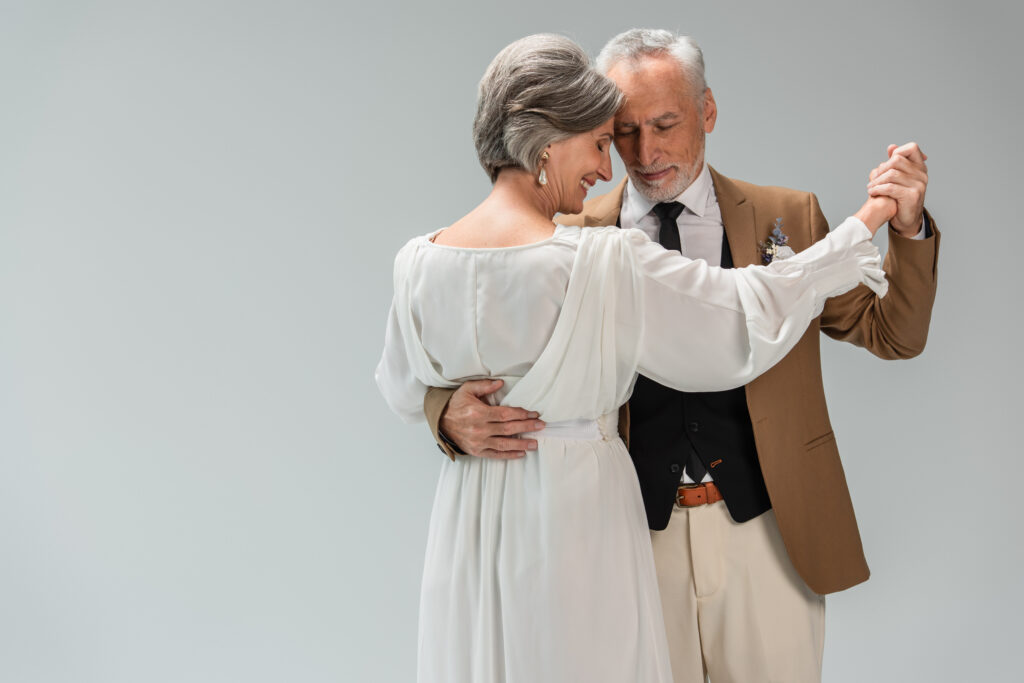
One of the most powerful emotional benefits of ballroom connection is shared responsibility.
The gentleman is not dragging.
The lady is not guessing.
Both are participating.
Psychologists note that emotional burnout often comes from feeling solely responsible—always leading, always reacting, always carrying the load. Ballroom offers a physical experience of mutual contribution, which translates directly into emotional relief.
You don’t have to do it all.
You just have to stay connected.
Presence Is the Real Product
You cannot scroll, rush, or mentally check out when you are connected through the Four Points of Contact. The dance requires:
- Attention
- Listening
- Trust
- Adaptability
Mindfulness research consistently shows that present-moment awareness reduces anxiety and improves emotional well-being. Ballroom teaches this not by sitting still—but by moving with another human being. Harvard Medical School shows that dancing activates multiple brain regions at once, reinforcing the connection between movement, emotion, and cognition.
Beyond the Dance Floor
Ballroom dancing has long been recognized for strengthening communication and social connection through shared movements. Students often report unexpected changes:
- Better communication in relationships
- Increased emotional wareness
- More confidence in social settings
- A greater sense of calm and connection
That’s because the Four Points of Contact train skills most adults rarely practice anymore: feeling, responding, and staying present with another person.
More Than Dance
Ballroom isn’t just about learning steps.
It’s about learning how to connect—clearly, calmly, and without words.
The Four Points of Contact don’t just guide movement.
They guide attention.
They regulate emotion.
They reconnect people to themselves and to others.
And in today’s disconnected world, that may be one of the healthiest things you can practice.
Connection isn’t something you talk about – it’s something you feel. Book your introductory lessons today and experience how powerful true nonverbal communication can be.
CLAIM YOUR INTRO OFFERFAQs
What are the four points of contact in ballroom dance?
The four points of contact in ballroom dance refer to the physical connection points between partners that allow clear lead-and-follow communication.
What are the four points of contact important?
They create structure, stability, and nonverbal communication between partners.
How do the four points of contact improve emotional connection?
By increasing physical awareness and responsiveness, dancers build trust and empathy without speaking.
Do beginners learn the four points of contact?
Yes. Even beginner ballroom dance lessons introduce these principles early.
Leave a Reply