

Personal Growth Through Ballroom Dancing: Why the Builder’s Mindset Makes It Compound
Most people don’t sign up for their first lesson thinking about personal growth through ballroom dancing.
They sign up for something simpler. A new hobby. A date night. A reason to get off the couch and try something they’ve quietly wanted to try for years.
And at first, that’s exactly what it is. Light. Fun. A little nerve-wracking, in a good way.
But the people who stay—the ones who keep coming back week after week—usually discover something they didn’t expect. The dancing changes, yes. But so do they. What started as an activity becomes a practice in personal growth through ballroom dancing, and it quietly reshapes how they handle everything else.
The difference between the people who get there and the people who drift away usually comes down to one thing: how they approach a challenge.
There Are Really Only Two Ways to Approach Growth
When something new gets hard—and ballroom always gets hard before it gets easy—people tend to do one of two things.
They build, or they react.
Both are completely human. Most of us have done both, in dancing and in life. But only one of them leads anywhere. The other keeps us circling the same starting line.
Understanding the difference is the whole game.
The Reactive Approach (and Why It Quietly Stops You)
The reactive approach feels like self-awareness, but it’s really just frustration wearing a disguise.
It sounds like this:
- “This is harder than I thought.”
- “I’m just not good at this.”
- “Maybe this isn’t for me.”
None of those thoughts are wrong, exactly. They’re honest. The problem is what they lead to: stopping. And then, a few months later, starting something else. And reacting to that the same way.
The reactive approach treats difficulty as a verdict—a sign you weren’t built for this.
So you quit, and you restart, and you quit again—never staying long enough in any one thing to get past the hard part where the good stuff lives.
The Builder’s Approach to Personal Growth Through Ballroom Dancing
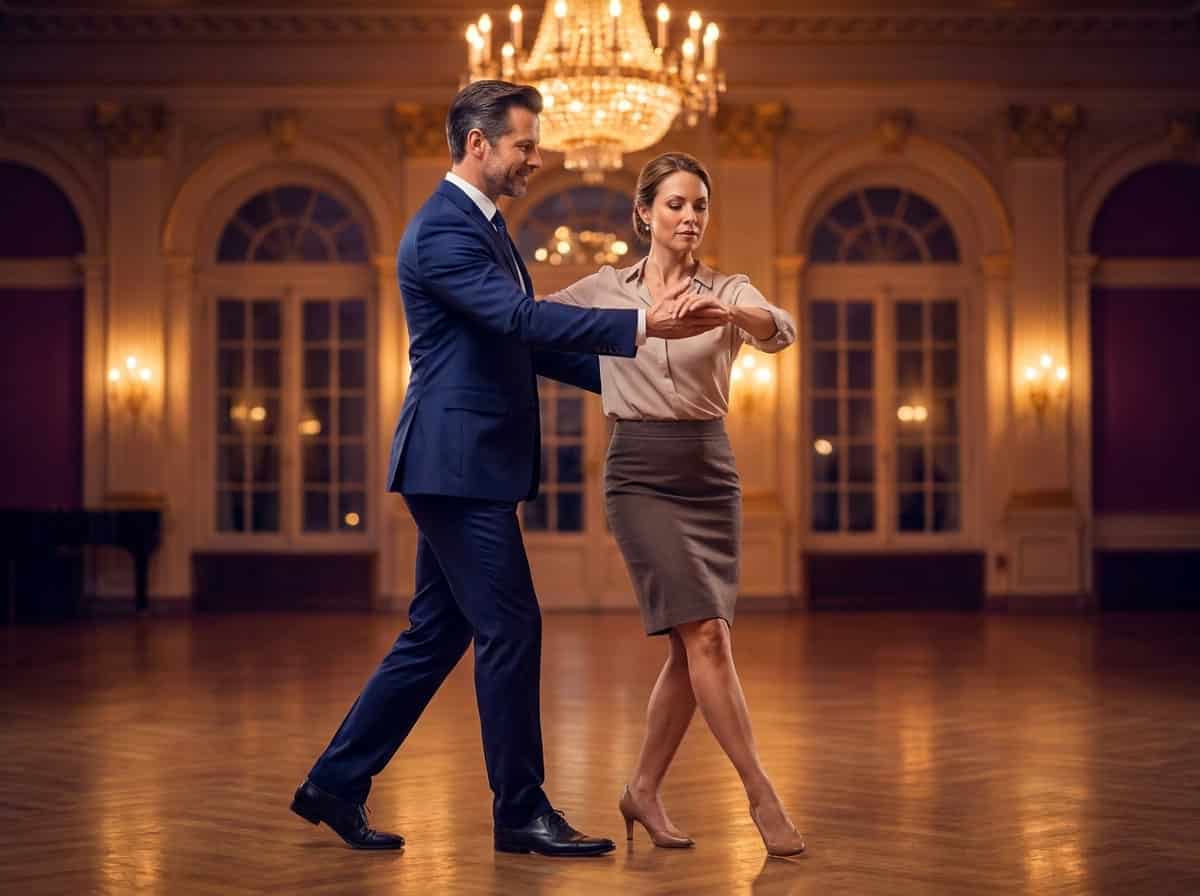
A builder hits the exact same wall. The footwork still falls apart. The timing still slips. But a builder asks a different set of questions.
- What specifically needs to improve?
- What skill am I missing right now?
- How do I actually fix it?
That small shift changes everything, and it’s the heart of personal growth through ballroom dancing.
Because on the dance floor, every struggle is just information.
Missed your timing? That’s feedback, not failure. Wobbling on a turn? That’s your balance asking for attention—a skill you can build. Feeling disconnected from your partner or your instructor? Connection is a craft, and it’s learnable like any other.
A builder doesn’t take any of it personally. A builder takes it as a to-do list.
This is what a growth mindset looks like in practice: the belief that ability is built through effort and good feedback, not handed out at birth. And ballroom gives you a place to practice it every single week.
Why Ballroom Is the Perfect Place to Practice Personal Growth
Here’s what makes dance such a powerful training ground: it’s a controlled environment.
In everyday life, the stakes can feel enormous. A mistake at work, an awkward moment socially—it’s hard to experiment when it feels like everything’s on the line.
The studio is different. It’s safe. It’s supportive. And there’s no audience while you learn—just you, the music, and an instructor whose entire job is to see what you’re capable of, not what you’re getting wrong.
So you get to run the loop over and over: face a challenge, adjust, improve. Face the next one, adjust, improve.
That loop is the most valuable thing in the room. More valuable than any single step you’ll learn.
And no, you don’t need a partner to do any of it. You never have. Your instructor is your partner during lessons, and you’ll find a whole community at group classes and socials. The work of building belongs entirely to you.
How the Builder’s Mindset Compounds Into Real Life

Skills compound. That’s the quiet magic of all of this. Every time you work through a frustrating step instead of abandoning it, you’re not just learning choreography—you’re rehearsing patience, practicing problem-solving, and building resilience.
And those don’t stay on the dance floor.
The patience you build waiting for a turn pattern to finally click shows up when you’re learning anything new. The resilience you develop after a clumsy lesson shows up the next time life hands you something clumsy. The problem-solving muscle gets stronger every time you break a big, intimidating goal into one small, fixable piece.
Research backs this up. The American Psychological Association notes that resilience is built, not inborn—strengthened through experience and the way we frame setbacks. And the Mayo Clinic points to regular physical activity as a reliable way to lift mood, sharpen the mind, and lower stress. Ballroom quietly delivers all of it at once.
Once someone learns to build in one area, they tend to build everywhere. It becomes who they are.
The Real Outcome: What Actually Lasts
So here’s the honest truth about personal growth through ballroom dancing.
The goal was never just to become a better dancer.
The goal—the thing that lasts long after you’ve learned the box step—is becoming someone who doesn’t flinch at a challenge. Someone who doesn’t get stuck. Someone who, when things get hard, already knows the move: ask what needs to improve, and start building.
Better dancing is what you’ll notice first. But a builder’s mindset is what you’ll keep.
That’s why people stay. Not because it stayed easy—because they became the kind of person who keeps going.
And that’s the most beautiful thing dance gives you. Life’s Better When You Dance—and it’s better still when you’ve learned to build.
Ready to Start Building?
You don’t have to be coordinated, experienced, or sure of yourself—you just have to start. Your first lesson is a friendly, no-pressure introduction, and no partner is ever needed. Come see what you’re capable of.
CLAIM YOUR INTRO OFFERFAQs
Do I need any dance experience to start?
Not at all—beginners are our specialty. Every student starts exactly where they are, and your lessons are built around your pace and your goals. The builder’s mindset isn’t about being good on day one; it’s about improving a little each time, and we’ll guide you through every step.
Do I need a partner to take ballroom lessons?
No partner needed—ever. Your instructor is your partner during lessons, and you’ll meet plenty of fellow students at our group classes and social events. Plenty of our students come solo and find a whole community waiting for them.
Is this really about personal growth, or just fitness?
Both, honestly. The movement is wonderful for your body, but personal growth through ballroom dancing runs deeper—it builds confidence, resilience, patience, and problem-solving that follow you off the dance floor. Most students are surprised by how much it changes beyond their fitness.
How quickly will I see progress?
Sooner than you’d expect. Most students feel a real shift by their third lesson—not just in their steps, but in their confidence. Progress compounds: each small skill you build makes the next one easier, and that momentum is what keeps people coming back.